
SIGMA Laboratory
Statistical Inference, Generative Modeling & Applications
통계추론 및 생성모형 연구실 | Department of Mathematical Sciences, UNIST
I am Young-geun Kim, a tenure-track Assistant Professor in the Department of Mathematical Sciences at UNIST. Before joining UNIST, I was the Hannan Endowed Visiting Assistant Professor in the Department of Statistics and Probability at Michigan State University (2024-2026) and a Postdoctoral Researcher in the Departments of Biostatistics and Psychiatry at Columbia University (2021-2024). I received my Ph.D. in Statistics from Seoul National University (2021).
📢 Openings (Open Until Filled)
- We welcome motivated undergraduate research interns and M.S. / Ph.D. students interested in statistical AI theory or biomedical/vision applications. Please contact Prof. Young-geun Kim (
younggeun91@unist.ac.kr) with your CV and transcript. - UNIST-UTA Joint RA: U.S. NIH-funded visiting research opportunity (up to 6 months) at the University of Texas at Arlington in neuroimaging AI. 👉 Program Details (PDF)
What is Statistical Generative Modeling?
High-dimensional data, across videos, languages, and biomedical records, can be governed by low-dimensional hidden factors (representations). SIGMA Lab combines Statistical Inference and Generative Modeling with Applications via deep learning to understand complex data with mathematical guarantees.
Our Mission: We build theoretically grounded Generative AI. We welcome students interested in either math/statistics theory or biomedical & video data!
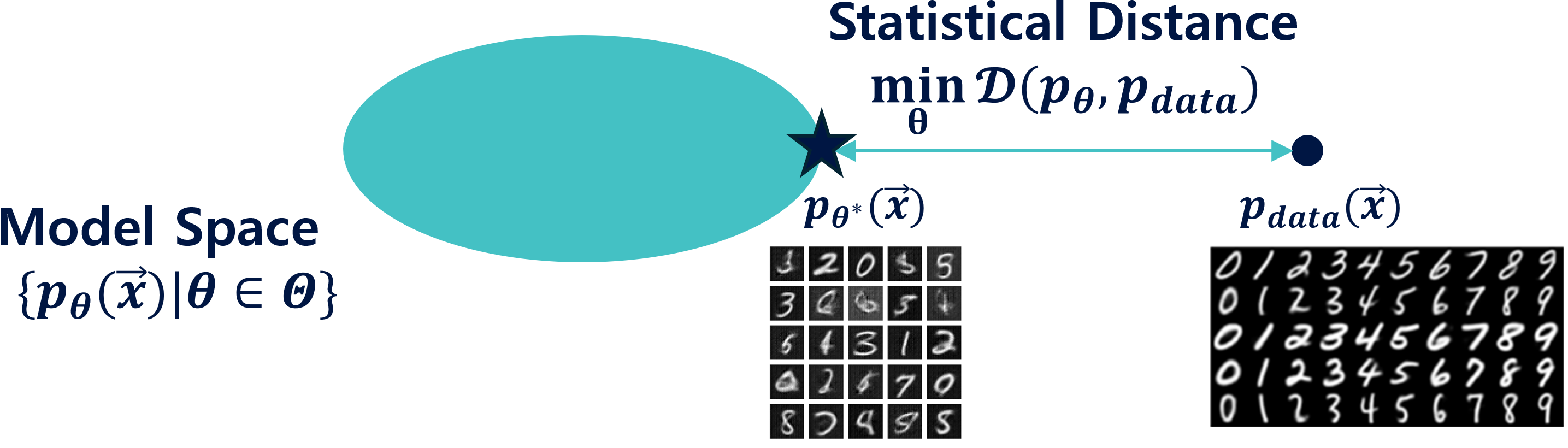 (a) Statistical Inference: Learning pθ*(x) via statistical distance D(pθ, pdata) | 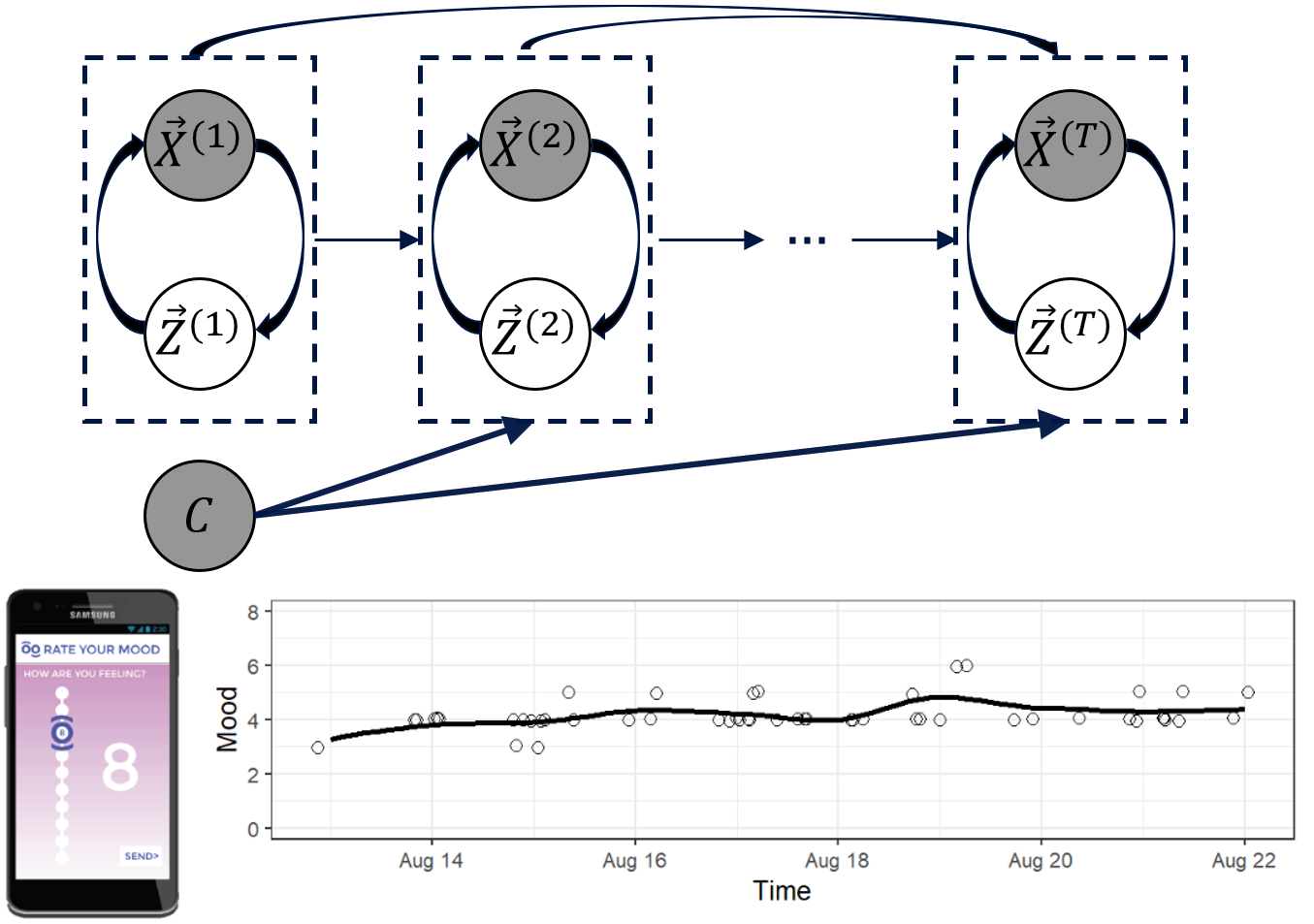 (b) Representation Learning: Extracting interpretable latent dynamics from mHealth data |
Research Fields
1. Theory: Probabilistic Modeling & Statistical Distances
Keywords: Deep Generative Models · Statistical Distance · Identifiability
We design latent variable models and optimal distance metrics with provable mathematical guarantees:
pθ(x) = ∫Z pθ(x | z) p(z) dz, θ* = arg minθ D(pθ, pdata)
- Statistical Distances: Conditional Wasserstein generators capturing high-dimensional data geometry without mode collapse.
- Identifiable Generative Models: Mathematical conditions ensuring unique recovery of true hidden factors (z), even under missing data.
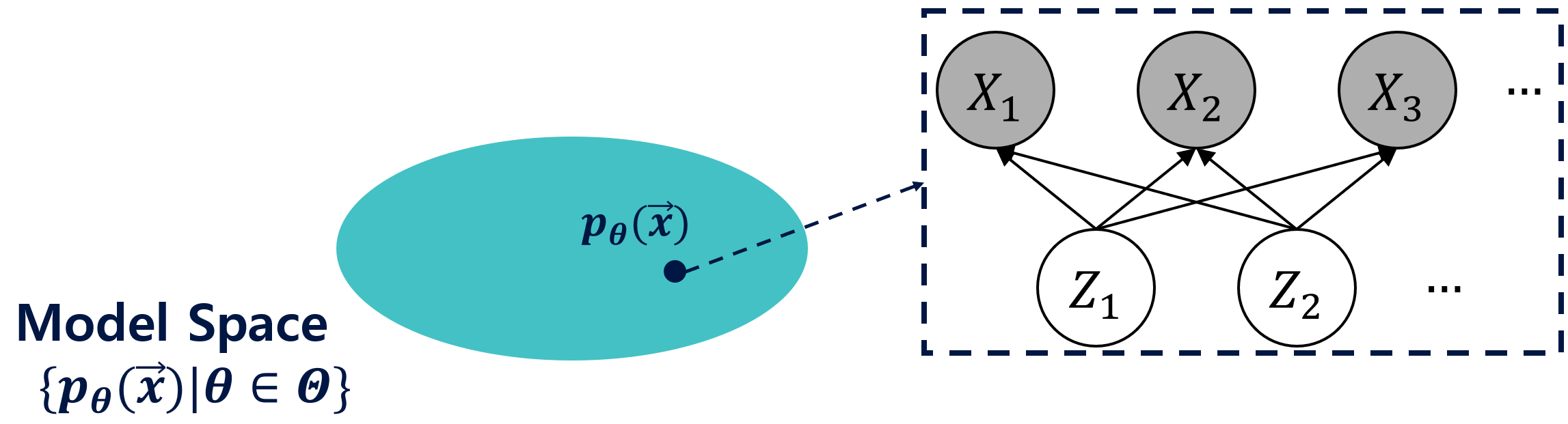 (a) Latent Variable Model: Latent (Z1, Z2) generates (X1, X2, X3) | ⇒ | 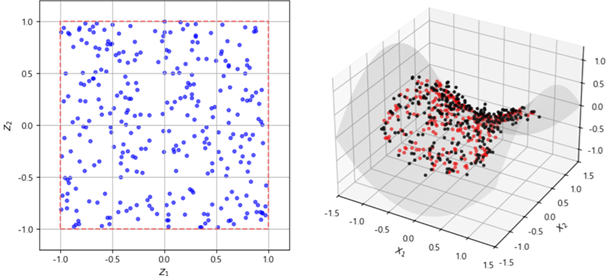 (b) Realization of (a): 2D (Z1, Z2) (left) & 3D (X1, X2, X3) (right) |
Key Related Research
- Kim, Y.-G., Lee, K., and Paik, M.C. (2023). Conditional Wasserstein generator. IEEE Transactions on Pattern Analysis and Machine Intelligence (TPAMI). [Paper] [Code]
- Kim, Y.-G., Liu, Y., and Wei, X. (2023). Covariate-informed representation learning to prevent posterior collapse of iVAE. AISTATS. [Paper] [Code]
- Kim, Y.-G., Kwon, Y., Chang, H., and Paik, M.C. (2020). Lipschitz continuous autoencoders in application to anomaly detection. AISTATS. [Paper] [Code]
2. Convergence: Medical Neuroimaging & Video AI
Keywords: Multi-modal Data · Neuroimaging · Video · Healthcare
Generative models deepen our understanding of data mechanisms, e.g., by disentangling shared (j) and modality-specific (im) factors given covariates c:
pθ(x1:M | c) = ∫J × I1 × ⋯ × IM (∏m=1M pθm(xm | j, im)) pθ(j, i1:M | c) dj di1:M
- Brain Imaging (MRI): Discovering autism and OCD biomarkers from incomplete multi-site cohorts (ABCD, ENIGMA) under block-missingness.
- Video & Image Synthesis: Predicting future frames and multi-view images via conditional Wasserstein and geodesic models.
- Digital Health & RL: Modeling mobile mood dynamics (EMA) and optimizing personalized clinical treatments via reinforcement learning.
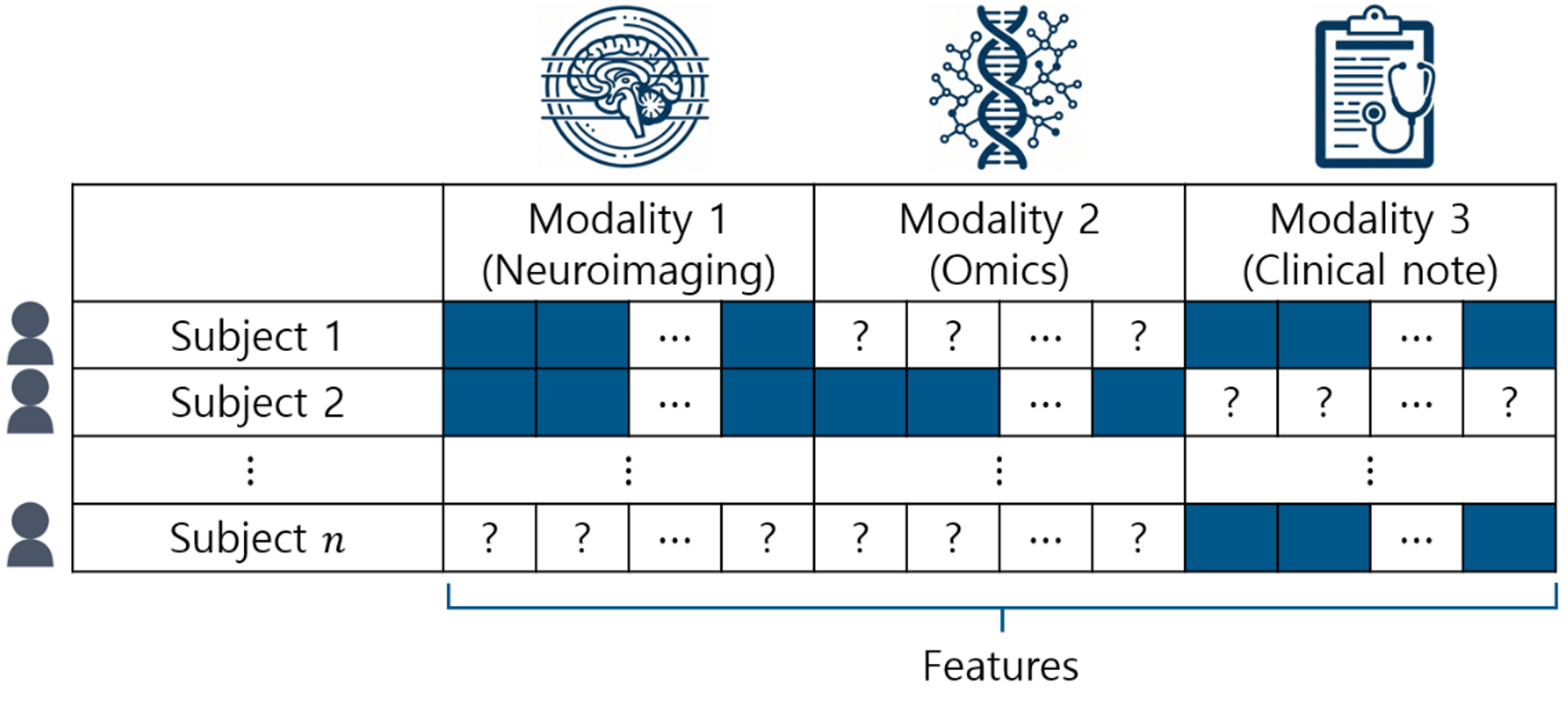 Incomplete Multi-modal Data: Site-specific block-missingness | ⇒ | 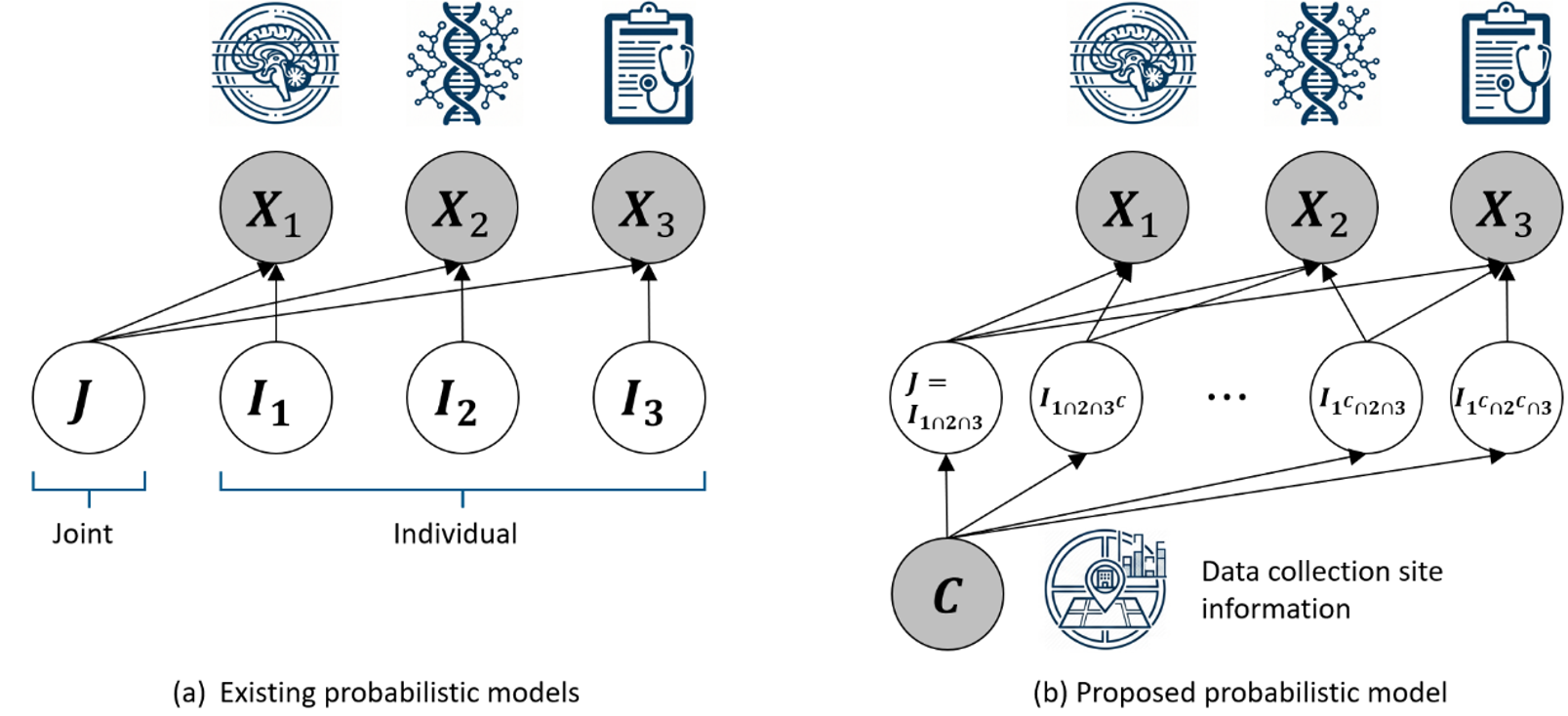 Covariate-Informed Disentanglement: Separating shared & subset-specific factors |
Key Related Research
- Kim, Y.-G. et al. (2024). Explaining deep learning-based representations of resting state functional connectivity data: focusing on interpreting nonlinear patterns in autism spectrum disorder. Frontiers in Psychiatry. [Paper] [Code]
- Kim, S., Kim, Y.-G., and Wang, Y. (2024). Temporal generative models for learning heterogeneous group dynamics of ecological momentary data. Biometrics. [Paper] [Code]
- Kim, Y.-G., Hu, M.-C., Nunes, E.V., Luo, S.X., and Liu, Y. (2025). Optimizing contingency management with reinforcement learning. IEEE ICHI (Long Presentation). [Paper] [Code]
Related Courses & Open Materials
- MTH345: Deep Generative Models: A Statistical Perspective (UNIST) [Course Material & Pilot Lecture Videos]
- MTH344: Mathematical Statistics (UNIST) [Course Material]
- STT997: Advanced Topics in Statistics (MSU) [Course Material]
- Related UNIST Courses: MTH342 (Probability), AI518 (Deep Generative Models)
Recent News
- [Fall 2026] Presenting invited talks on Multi-Modal Representation Learning with Partially Pairwise Observations at CFE-CMStatistics 2026 (Berlin, Germany) and the KMS Fall Conference (Gwangju).
- [09-01-2026] Launched a newly developed undergraduate course at UNIST: MTH345: Deep Generative Models: A Statistical Perspective.
- [Summer 2026] Presented invited talks at ICSA-China 2026 (Shenzhen, China) and the KSS Summer Conference (Gyeongju).
- [03-12-2026] Our proposal for new course development (Deep Generative Models: A Statistical Perspective) has been accepted by UNIST (KRW 20,000,000, 04/2026-07/2026, Role: Principal Developer).
- [02-01-2026] Joined the Department of Mathematical Sciences at UNIST as a tenure-track Assistant Professor.
- [08-06-2025] Our grant proposal (Statistical Understanding of Adversarial Training in Neural Networks, USD 180,000, 08/2025-07/2028) has been funded by the U.S. National Science Foundation (NSF DMS) (Role: Co-PI & Int’l Consultant; PI: Dr. Yue Xing, MSU).
- [03-27-2025] Paper accepted at MIDL 2025: A Novel GNN Framework Integrating Neuroimaging and Behavioral Information to Understand Adolescent Psychiatric Disorders.
- [03-12-2025] Paper accepted at IEEE ICHI 2025 (selected as a long presentation): Optimizing Contingency Management with Reinforcement Learning.